

Taking time out to reflect on last year and planning for 2026
A 15-minute worksheet to get you started...

After working with leaders for over two decades, we’ve observed that many may have achieved remarkable professional success whilst simultaneously compromising their personal lives—their family relationships, physical health, friendships, and sense of fulfilment. It’s a familiar tragedy, one that repeats itself year after year in locker rooms, boardrooms and C-suites across the country.
We’ve also learnt that where there’s a balanced LifePlan, work becomes more meaningful, effective, and sustainable. This isn’t just our thinking—it’s a strategic imperative grounded in decades of evidence.
The Five F’s Framework
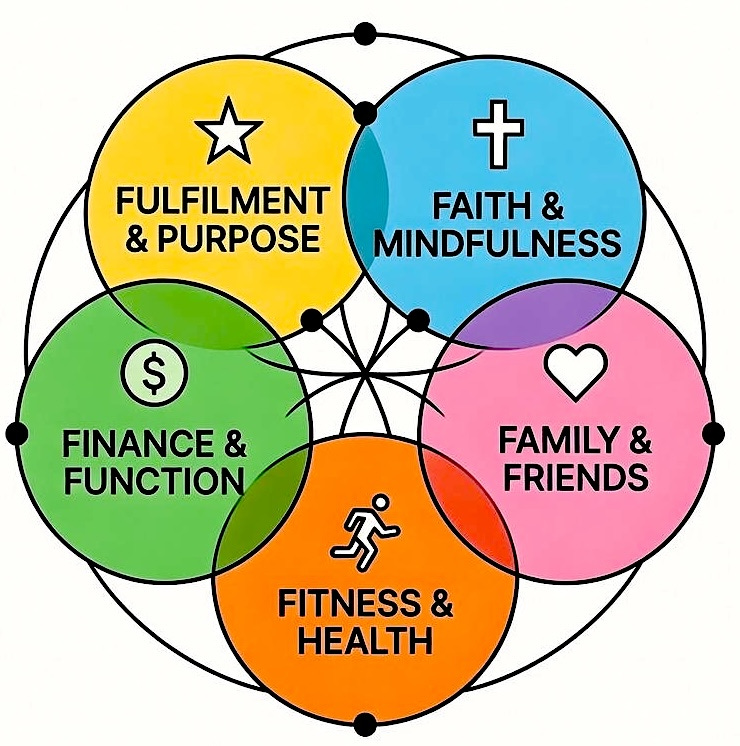
Our Five F’s framework reimagines how we think about human wellbeing. Unlike traditional hierarchical models, it presents five interconnected pursuits that must be balanced simultaneously: Faith & Mindfulness, Family & Friends, Fitness & Health, Finance & Function, and Fulfilment & Purpose.
It starts with your internal state rather than external needs. It recognises that a stable inner world—clear values, mental clarity, resilience—is the true foundation for building meaningful relationships, maintaining health, achieving financial stability, and ultimately living with purpose.
As we’ve written elsewhere, paying attention to the human context helps us better understand people. It provides the framework for candour, connection, and sustainable performance.
The Rule of Three
Here’s a key insight from our work with proven leaders, millionaires, and billionaires: success can be condensed into three factors—the goals we set, the company we keep, and the disciplines we form.
When reviewing your year, apply the rule of three to each life area. Any more than three commitments, and the likelihood of follow-through declines dramatically. This isn’t about limiting ambition—it’s about ensuring execution.
From Reflection to Action
The worksheet we’ve created guides you through a structured annual review across all five F’s. It asks you to identify what worked, where you fell short, and what commitments you’re willing to make. Critically, it includes pattern recognition—what keeps repeating year after year that you want to change?
This matters because, as we know from our work implementing disciplines in organisations, sustained success comes from continual incremental improvements. Like the San Antonio Spurs “pounding the rock” daily, transformation happens through consistent effort, not dramatic gestures.
The Work section addresses purpose, people, and performance. It challenges you to revisit your professional WHY, align behaviours with values, evaluate your network, and establish clear accountability mechanisms.
The Cost of Success
Results require disciplined effort—a cost, a price to be paid upfront, and at least proportionate to the desired outcome. This principle applies equally to life and work.
As we commence a new year, take time to reflect honestly across all five areas of your life. Write it down. Commit to the hard work. Because the greatest tragedy isn’t failing—it’s doing well what should not be done at all.